There are kings and queens, wrapped in yards of silk. There are wealthy merchants and powerful stadtholders, whose heavy-lidded stares are preserved in the brushstrokes of Rembrandt, Rubens, and Van Dyck. And, perhaps, most celebrated among them all is a doe-eyed girl with a pearl earring-one of a handful of paintings by Johannes Vermeer. But I was not there for them.
Amidst the stiff-collared gloom of the great Dutch Masters at Mauritshuis, I searched for a foreigner.
I have long admired the work of the German portraitist Hans Holbein the Younger (1497–1543). His efficient yet elegantly contoured linework pulled portraiture out of Medieval flatness and into a Renaissance of dimension. For this unique ability and economy, he earned patronage at the Tudor court as a painter for Henry VIII of England. It is Holbein’s portrait of Robert Cheseman, hanging in this small, royal gallery at The Hague in the Netherlands, that first attracted me to this museum over a decade ago.
An obscure English nobleman, Cheseman is an unremarkable subject. It is the falcon perched on his gloved hand that gives the portrait a story. Though he is often mistaken as the king’s falconer because of Holbein’s depiction, there is no historical evidence that Cheseman held that office. Rather, art historians believe that the falcon functions here as a symbol of status. By Tudor times, falconry—an umbrella term for sporting with all birds of prey, not just falcons—had become associated with nobility.
But falconry has humble roots. Developed 4,000 years ago on the steppes of Mongolia (some historians place its origins earlier on the Arabian peninsula), it was and still is used in that part of the world as a means of hunting for food. Spreading westward over centuries, the art of training birds of prey had become so firmly established in Europe by the time of William Shakespeare that the great bard wove dozens of references to the avian sport into his works, and thus into the English colloquy: “hoodwinked” (Romeo and Juliet), “scarf the eye” (Macbeth), “haggard” (Taming of the Shrew), and “bated breath” (Merchant of Venice), among many others.
A few months ago, I returned to see Cheseman, who now appears next to another Holbein portrait of an unnamed nobleman with a hawk. I admired the ancient pair, whose world seems so distant from mine. But on that gloomy day in the Low Countries of Europe, little did I suspect that the proximity between us would soon be shortened on an upcoming trip to the Lowcountry of South Carolina.
Steve Hein, director at the Center for Wildlife Education and the Lamar Q. Ball Jr. Raptor Center at Georgia Southern University, which he helped found in 1991, participated in this year’s
Field + Fire weekend at Palmetto Bluff. He was first introduced to falconry as a hobbyist and is now an expert and one of a few thousand falconers in the United States.
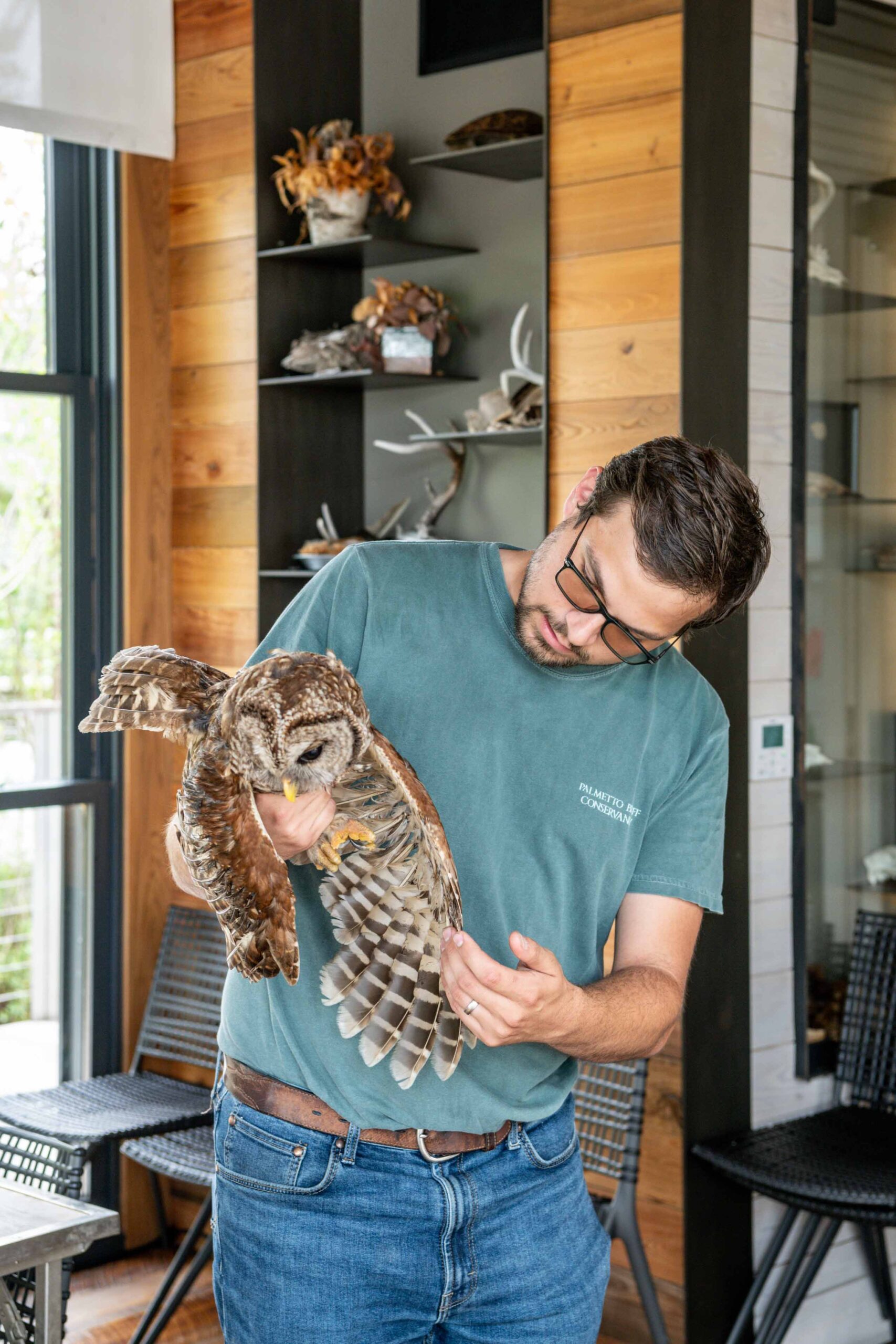
In an exhibition at Wilson Village, Hein paraded a stunning pageant of live raptors for us to see and touch. There was a beautiful, dusty-blue peregrine falcon, which can reach speeds up to 240 mph. There was a bald eagle named Freedom and a gorgeous eagle owl, whose talon grip is eight times more powerful than a human hand. There was also a fluffy little screech owl that elicited soft coos from the audience.
But these birds are predators, Hein reminded us. Majestic and sometimes cute, their rightful place at the apex of the food chain should not be forgotten. While they can be trained by humans, they are, by nature, hunters.
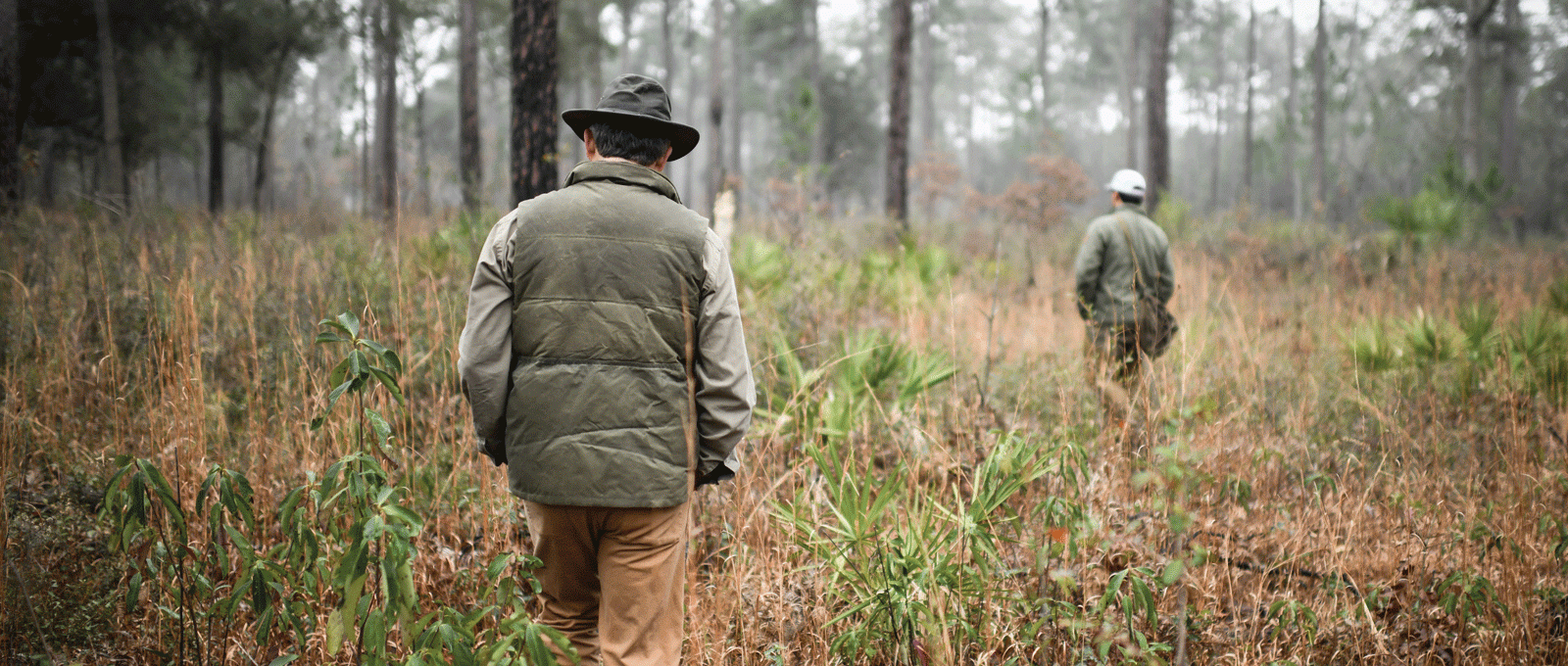
I witnessed this the next day when Hein and his son, Adam, who owns On the Fly Outfitters in Brunswick, Georgia, took a handful of us into the Lowcountry forests of Palmetto Bluff. Hein sent his pointing dogs into the brush and released a Harris’s hawk into the trees. A particularly sociable raptor, this breed can be trained to hunt cooperatively. As the dogs sniffed their way through the woods, the hawk followed from tree to tree. When the dogs flushed a chucker, the hawk swooped down for the kill.
We repeated this with a goshawk, a particularly fast and agile bird. It quickly downed another chucker midflight.
Opportunistic hunters, raptors are capable of killing ground quarry as well. They can prey on rabbits and even small dogs. To demonstrate this, Hein released the hawk again. Within minutes, it spotted a gray squirrel high in an oak. A chase ensued. The squirrel, cornered, leapt. As we watched it sail from one branch to another, the hawk intercepted it midair. Gripping its catch, the bird glided down to the brush with its prize.
Hein is mindful that these pursuits are sport—one of the most regulated forms of hunting in the United States. But he is also quick to point out that, before noblemen and kings, falconry was and still is a testament to man’s ability to observe and harness nature for survival.
%GALLERY%
Photography by Bonjwing Lee